


Buyers no longer want to piece a deal together from scattered emails, PDF attachments, and shared drive links. They want one place to see the proposal, the pricing, the recorded demo, and a clear list of next steps. That single place is what the sales technology industry now calls a digital sales room (DSR): a secure, branded workspace where sellers and buyers collaborate on one deal from first meeting to signed contract.
The category has grown quickly. Analysts at Gartner have projected that roughly 30% of B2B sales cycles will run through a digital sales room instead of email and ad-hoc file sharing, and G2 alone lists dozens of vendors under its Digital Sales Room category. That growth has also produced a crowded, confusing market, where nearly every vendor claims to be the best fit for every team.
This guide narrows that list eight platforms that consistently show up in independent buyer research and G2’s category rankings, and explains what each one does well, where it falls short, and who it’s built for.
How We Evaluated These Platforms
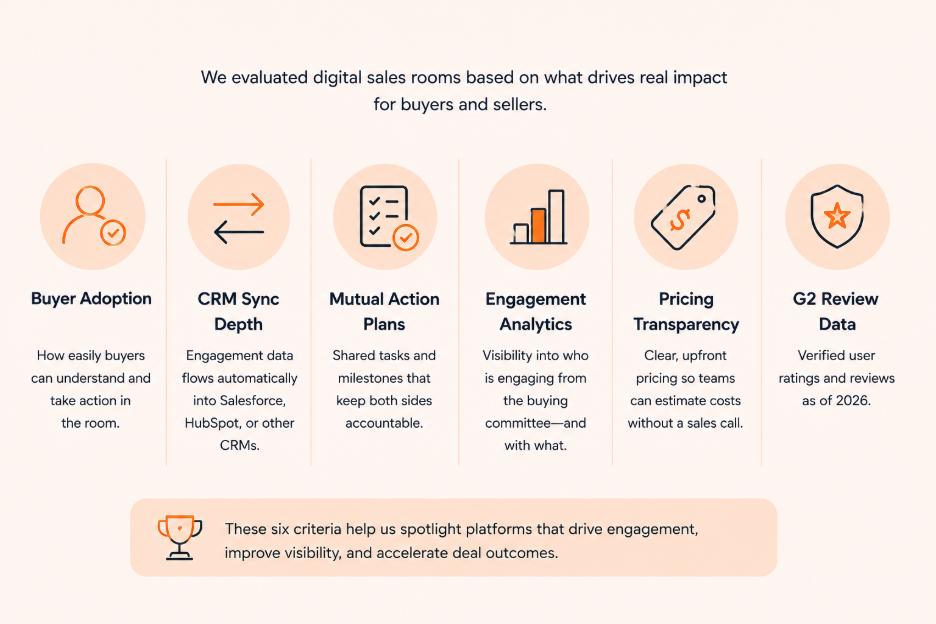
Digital sales rooms are judged less on feature count and more on whether buyers actually open and use them. For this list, we weighted:
- Buyer-side adoption and ease of use: how quickly a buyer can understand and act inside the room.
- CRM sync depth: whether engagement data (views, downloads, new stakeholders) flows automatically into Salesforce, HubSpot, or another CRM.
- Mutual action plan support: shared task lists and milestones that keep both sides accountable.
- Engagement analytics: visibility into who on the buying committee is actually engaging, and with what.
- Pricing transparency: whether a team can get a realistic cost estimate without a sales call.
- G2 review data: verified user ratings as of 2026.
Top 8 Digital Sales Room Platforms in 2026
1. Projetly
Projetly is an AI-native digital sales room built for complex enterprise B2B deals. What sets it apart from most of the platforms below is continuity: the same workspace a rep builds during the sales cycle converts automatically into a customer onboarding project once the deal closes, instead of ending at signature.
Key features: Branded, centralized deal workspaces; AI meeting intelligence that transcribes and summarizes calls and extracts action items; stakeholder-level engagement analytics; mutual action plans with shared tasks and milestones; and an automated sales-to-onboarding handoff, backed by AI agents that monitor onboarding progress and flag adoption risk after the sale.
Limitations: built specifically for complex, multi-stakeholder enterprise sales rather than transactional, single-buyer deals, and it isn’t positioned as a training or certification platform.
Pricing: Custom, scoped to deal volume and onboarding needs.
G2 Rating: 4.8/5.
Best for: Enterprise B2B teams that want the deal room to carry stakeholder context straight through into onboarding, rather than starting over with a new tool after close.
2. Aligned
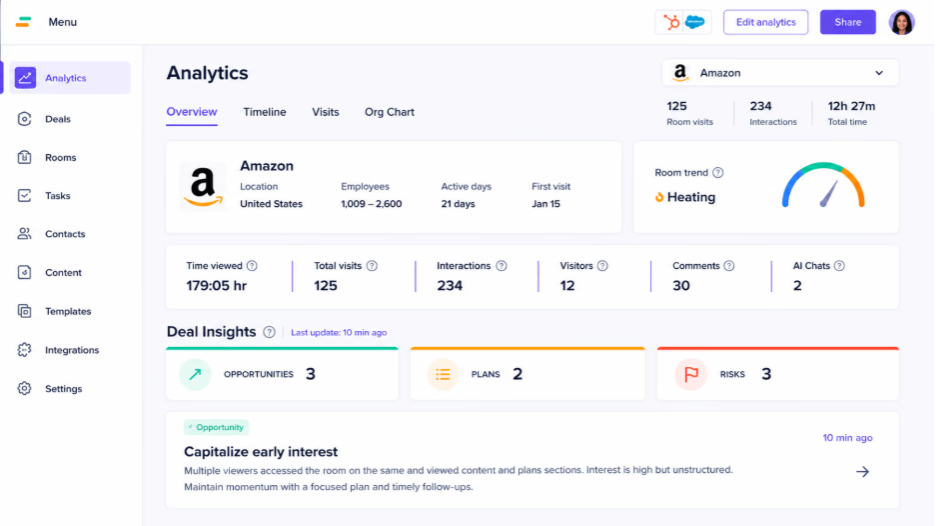
Aligned combines a digital sales room and a post-sale client portal into a single workspace, so the same room a prospect used during evaluation carries into onboarding and renewal. G2’s Summer 2026 Grid Reports named Aligned the #1 Digital Sales Room in the Small Business and Mid-Market segments.
Key features: stakeholder mapping, mutual action plans, an AI copilot that auto-builds deal resources after calls, and room-level engagement analytics.
Limitations: Native Salesforce and HubSpot sync is only available on the Enterprise plan, which requires custom pricing.
Pricing: Free Starter plan; Basic starts at $29 per seat per month; Enterprise is custom.
G2 Rating: 4.6/5.
Best for: mid-market teams running multi-stakeholder deals that want the same workspace to continue after close.
3. GetAccept
GetAccept bundles a digital sales room with proposal creation, CPQ, and e-signature in one platform, positioning itself as an all-in-one alternative to running separate point solutions. It’s also the only major DSR vendor with a native Microsoft Dynamics integration, in addition to Salesforce and HubSpot.
Key features: configure-price-quote tools, legally binding e-signatures with audit trails, personalized video messaging inside the room, and real-time content tracking.
Limitations: Several G2 reviewers note a steeper learning curve during initial setup compared to lighter-weight tools.
Pricing: plans start around $25–$49 per user per month, scaling with features and integrations.
G2 Rating: 4.6/5.
Best for: mid-market and enterprise teams that want proposals, e-signature, and the deal room consolidated into one vendor.
4. Trumpet
Trumpet describes itself as an AI-powered GTM workspace built around branded digital sales rooms, or “pods,” where content, mutual action plans, and e-signatures live together. G2 reviewers frequently cite its design flexibility as a differentiator from more templated competitors.
Key features: highly customizable room design, AI-surfaced content recommendations by deal stage and persona, and native Salesforce integration.
Limitations: As a newer, design-forward tool, some reviewers want more advanced reporting depth for very large enterprise deployments.
Pricing: per-seat monthly pricing with a free trial; exact tiers are quote-based.
G2 Rating: 4.7/5.
Best for: SaaS sales teams that want a visually distinctive buyer experience without a heavy implementation.
5. Dock
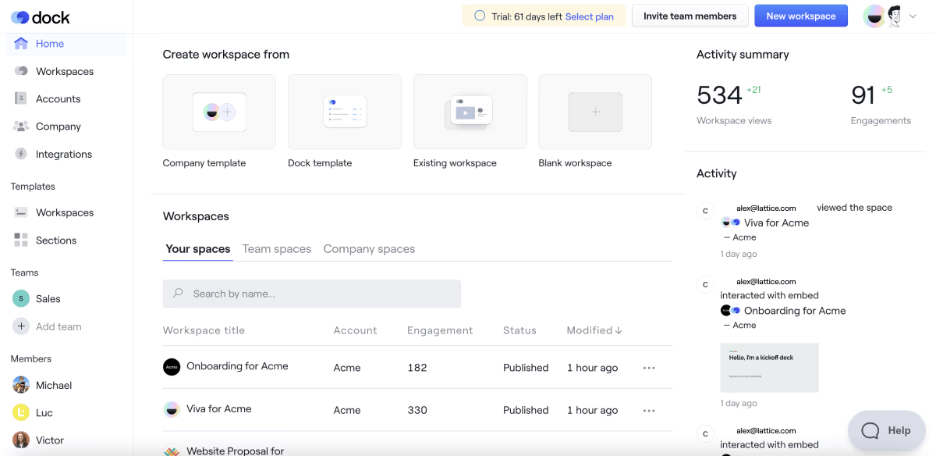
Dock takes a more structured, checklist-driven approach to the digital sales room, optimized for handing a deal cleanly from sales into onboarding and customer success once it closes.
Key features: Personalized client portals, mutual action plans, and clean post-sale handoff workflows built specifically for the sales-to-CS transition.
Limitations: Pricing is flat rather than fully per-seat, which can make cost planning less intuitive for growing teams that add users gradually.
Pricing: plans start free, with paid tiers around $350 per month for a small team, plus additional per-seat costs beyond the included users.
G2 Rating: 4.7/5.
Best for: teams that prioritize a simple, low-friction setup and a clear path from closed deal into onboarding.
6. DealHub
DealHub started as a CPQ (configure-price-quote) platform and has since added deal-room capabilities on top of its quoting and contract workflows. It’s a strong fit for teams whose sales process is anchored around pricing accuracy and approvals rather than long-form content.
Key features: Dynamic pricing tables, guided selling playbooks, contract lifecycle management, and e-signature, all inside one workspace.
Limitations: Several G2 reviewers describe DealHub’s deal rooms as more static and template-driven than purpose-built DSR tools, with less room for self-service customization.
Pricing: custom, with reported ranges around $25–$100 per user per month depending on tier.
G2 Rating: 4.7/5.
Best for: teams with complex, pricing-heavy deals that want quoting, contracts, and the buyer room in a single system.
7. Highspot
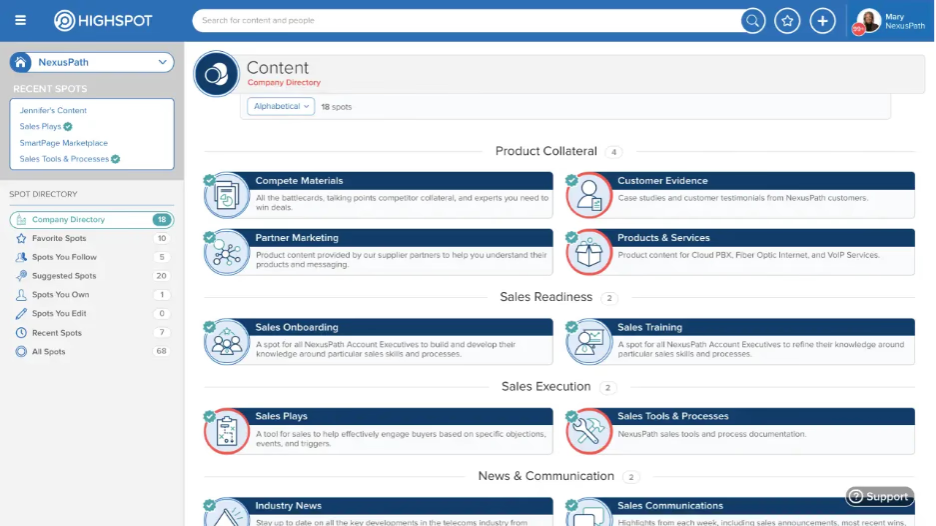
Highspot is primarily a sales enablement platform, built for content management, guided selling, and CRM-embedded playbooks that has extended into digital sales rooms as one feature among many. It’s frequently shortlisted by enterprise teams that also need internal content governance.
Key features: centralized content search, guided-selling playbooks tied to deal stage, and analytics linking content usage to pipeline outcomes.
Limitations: The digital sales room is a feature inside a broader enablement suite rather than the core product, and pricing is custom-only. It’s also worth noting that Highspot and Seismic announced a definitive agreement in February 2026 to combine under the Seismic brand; the deal had not closed as of this writing, which is worth factoring into any purchase decision made today.
Pricing: custom, available on request.
G2 Rating: 4.7/5.
Best for: Enterprise teams that want guided selling and content governance built into the CRM, with a deal room as part of that footprint.
8. Seismic
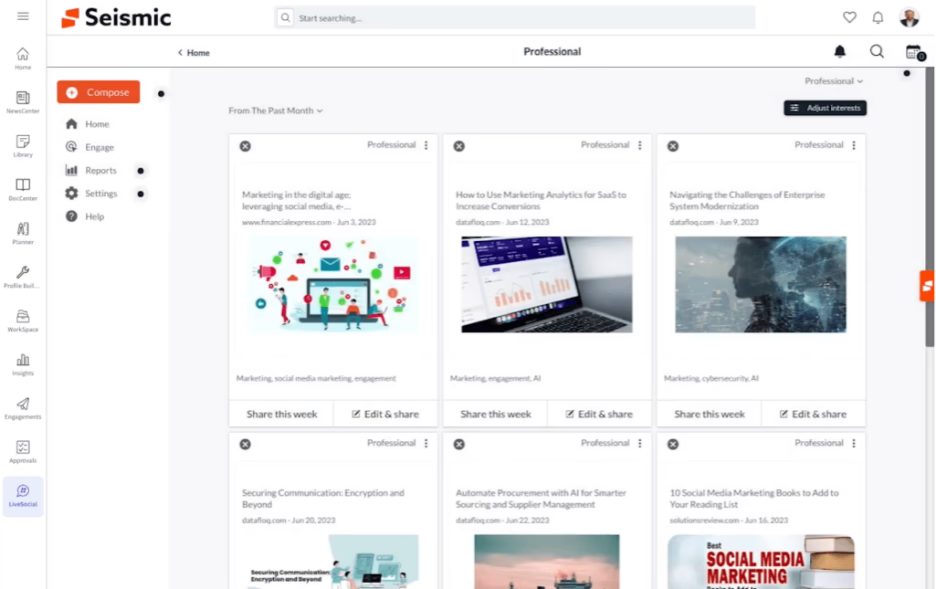
Seismic is the other half of that pending merger and, like Highspot, treats the digital sales room as an extension of a larger content and enablement platform rather than a standalone product.
Key features: LiveDocs for automated document generation, LiveSend for page-level buyer engagement tracking (including guest access without a Seismic account), and deep content governance controls for regulated industries.
Limitations: implementation timelines commonly run several months, and the platform carries a real learning curve for day-to-day users.
Pricing: per-user/month, varying by edition and add-on modules; not sold as a standalone DSR product.
G2 Rating: 4.6/5.
Best for: large, regulated enterprises that need strict content governance alongside buyer-facing rooms.
How to Choose Between Them
There’s no single “best” digital sales room for every team, because the right fit depends on deal size, sales motion, and what’s already in your stack:
- Enterprise deals that need to survive past signature: Projetly is built specifically to carry the workspace into onboarding automatically.
- High-volume, mid-market deals: prioritize fast room setup and template reuse, Aligned and Trumpet lead here.
- Pricing-heavy, complex quoting: DealHub’s CPQ-first approach reduces quoting errors inside the room itself.
- Full proposal-to-signature in one tool: GetAccept consolidates e-signature and CPQ alongside the room.
- Clean handoff into customer success: Dock is built specifically around that transition.
- Enterprise content governance: Seismic and Highspot fit teams that already centralize content and training, though their pending merger is a factor to watch through 2026.
Whichever platform you shortlist, ask for a real trial deal room rather than a static demo. A digital sales room only earns its cost if your buyers actually open it. G2 reviewers across nearly every platform on this list flag “buyer adoption,” not feature count, as the real differentiator.
Frequently Asked Questions
- What is a digital sales room?
A digital sales room is a secure, branded online workspace where sellers and buyers collaborate on a single deal, replacing scattered email threads and shared folders with one hub for content, communication, and next steps throughout the sales cycle.
- How is a digital sales room different from a sales enablement platform?
Sales enablement platforms, like Highspot and Seismic, are primarily internal tools for content management, rep training, and coaching. A digital sales room is buyer-facing, it’s the external environment where the actual deal happens. Many enablement platforms have added a digital sales room as one feature, while dedicated DSR vendors build the buyer experience as the core product.
- Which digital sales room platform is best for enterprise deals?
Projetly, Highspot, and Seismic are typically the strongest fit for large, multi-stakeholder enterprise deals, though they differ in focus: Projetly is built to carry the workspace into onboarding automatically, while Highspot and Seismic lean toward content governance and guided selling inside the CRM.
- Do digital sales rooms integrate with CRM software?
Most platforms on this list sync with Salesforce and HubSpot to some degree, and GetAccept also offers native Microsoft Dynamics integration. Sync depth varies by vendor and plan, some, like Aligned, restrict full CRM sync to their top-tier plan, so it’s worth confirming integration depth before signing.
- How much does digital sales room software cost?
Pricing varies widely by platform and deployment size. Some tools publish per-seat pricing starting in the $25–$50 per user per month range, while enterprise-focused platforms like Seismic, Highspot, and Projetly use custom, quote-based pricing scoped to deal volume and integration needs.
